
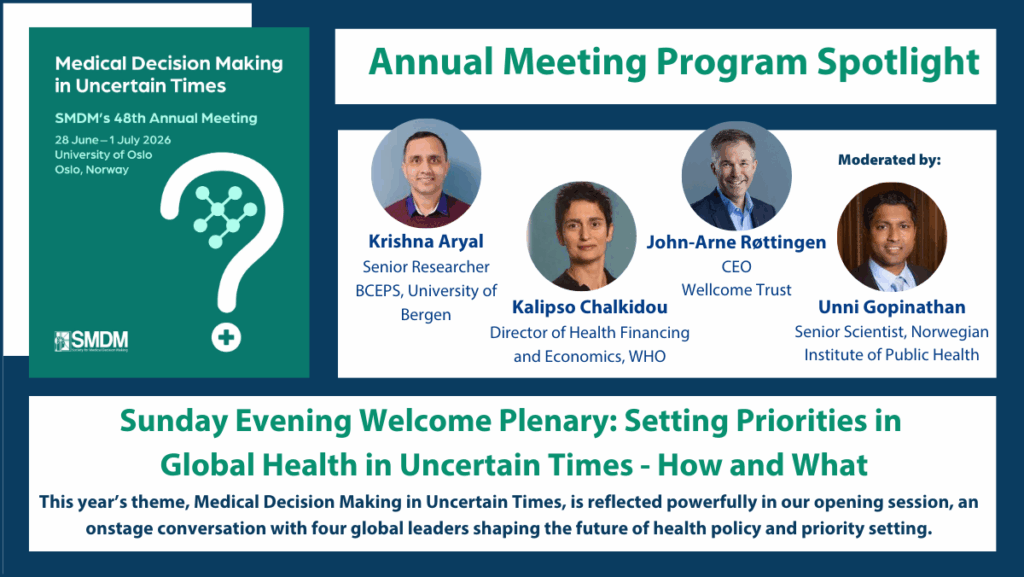
Panelists
- Krishna Aryal, Senior Researcher, Bergen Centre for Ethics and Priority Setting in Health (BCEPS), University of Bergen
- Kalipso Chalkidou, Director, Performance, Financing and Delivery (PFD) Department, World Health Organization (WHO)
- John-Arne Røttingen, Chief Executive Officer, Wellcome Trust
Moderator: Unni Gopinathan, Senior Scientist, Norwegian Institute of Public Health
Background: Global health’s unprecedented structural transformation
Three forces have converged in global health, making priority-setting under uncertainty more pressing than ever. First, a broad-based pullback in donor funding across most major contributors. For example, the Global Fund’s 8th Replenishment closed roughly 37% short of its target,[1] Gavi 6.0 fell about USD 2.5 billion short of its proposed budget,[2] and overall development assistance for health dropped an estimated 21% from 2024 to 2025.[3] Second, a US-specific shift that is both fiscal and institutional — the dissolution of USAID, withdrawal from WHO, and a pivot from multilateral collaboration to a bilateral approach under an “America First” strategy. Third, a wider geopolitical mistrust rooted in COVID-19 vaccine inequity, now visible in the stalled negotiations over a Pathogen Access and Benefit-Sharing (PABS) agreement, where LMICs and high-income countries remain divided and the May 2026 WHA deadline has slipped to 2027.
Priorities are being forced at every level: at the frontline, as underfinanced facilities and staff make tough choices about which services to preserve; at the national level, as ministries decide how to expand access efficiently and equitably; at the regional level, as new and existing bodies seek to absorb functions from global institutions to be more responsive to local needs; and at the global level, as the institutions themselves debate what to streamline, merge, or sunset.
Much of the global conversation still circles around hopes that obscure the actual decision space: that domestic mobilisation will close the gap, or that global architectural reform can avoid the hardest trade-offs. To move past these, the open plenary proceeds from four key premises, from which workable solutions must be built. These premises bring into sharp focus the trade-offs that countries, and the institutions meant to support them, must now manage.
Key premises
Premise 1. Funding cuts will not be replaced — and these shifts, in both quantity and quality, are already reshaping priorities. Neither the remaining bilateral donors, philanthropy, nor recipient governments will, in aggregate, replace the lost resources. The shifts are changing in quality as well as quantity: hard conditionalities and co-financing requirements risk pushing financing toward specific diseases and away from country-driven health systems strengthening efforts, and toward priorities that sideline national deliberative processes and risk reproducing the distorting incentives of development assistance for health in the past.
Premise 2. Most LMICs cannot, in the short to medium term, fully finance an essential package of health services. Debt service, narrow tax bases, and political constraints mean even ambitious domestic mobilisation plans will not close the gap within the next decade. Importantly, the binding constraints on the resource envelope lie largely outside the health sector — in debt, tax, and fiscal-transfer decisions — wider issues that shape health priorities but that the global health field has so far insufficiently engaged with.
Premise 3. There is broad agreement that the global health system must become leaner — but no agreement on what functions the global level should prioritise, or where to cut, merge, and consolidate. Multiple global dialogues, the Wellcome regional dialogues, the Lusaka Agenda, the Accra Reset, and other parallel initiatives converge on the diagnosis but not the prescription.
Premise 4. A self-interest argument is increasingly driving donor decisions, with implications for which priorities are defended and carrying potential tensions with country-led processes. The America First Global Health Strategy is the most explicit example, but arguments in many other countries — for example casting pandemic preparedness as domestic biosecurity — increasingly justify global health investments on national-interest grounds. Which investments still fit within this logic, and which trade-offs can be defended on other grounds, is now an open question.
Plenary focus
This plenary starts at the country level, focusing on what these choices look like on the ground, and from there broadens its focus to what they mean for the global health institutions, wider initiatives, and philanthropic actors aiming to support countries in managing these trade-offs. Running through it is a question about what these choices demand of how we institutionalise health technology assessment (HTA) and strengthen priority-setting capacity — as a tension becomes apparent between the frameworks, tools, and methods the field has built, and the systems-level, programmatic decisions now being forced on countries and global institutions alike.
The three panelists will speak to these questions from different perspectives. Krishna Aryal will begin at the country level — what priority-setting actually looks like, the choices being forced on policymakers, how countries are responding, and where global support falls short. Kalipso Chalkidou will then broaden the focus and surface the trade-offs already being made — within health, across sectors, and through aid conditionality — and what this means for global institutions and their role in supporting countries with managing priorities. Finally, John-Arne Røttingen will look ahead to the reforms acutely needed, the evidence systems required to support country choices, and where science-based philanthropy can make a distinctive difference. A moderated discussion will follow, with opportunities for questions and engagement from the audience.
[1]Madan Keller, Janeen, Rachel Bonnifield, and Pete Baker. 2026. A Radically Simplified Global Fund to Meet the Moment. CGD Brief. Center for Global Development, February 5. Available at: cgdev.org/publication/radically-simplified-global-fund-meet-moment
[2]Madan Keller, Janeen, Rachel Bonnifield, Tom Drake, Pete Baker, and Orin Levine. 2025. How Gavi 6.0 Can Take a Bigger Leap. CGD Brief. Center for Global Development, July. Available at: cgdev.org/publication/how-gavi-60-can-take-bigger-leap
[3]Institute for Health Metrics and Evaluation. Health financing. https://www.healthdata.org/research-analysis/health-financing